
REVIEW · SAIGON CITY TOURS
Saigon: City Sightseeing Hop-On Hop-Off Bus Tour
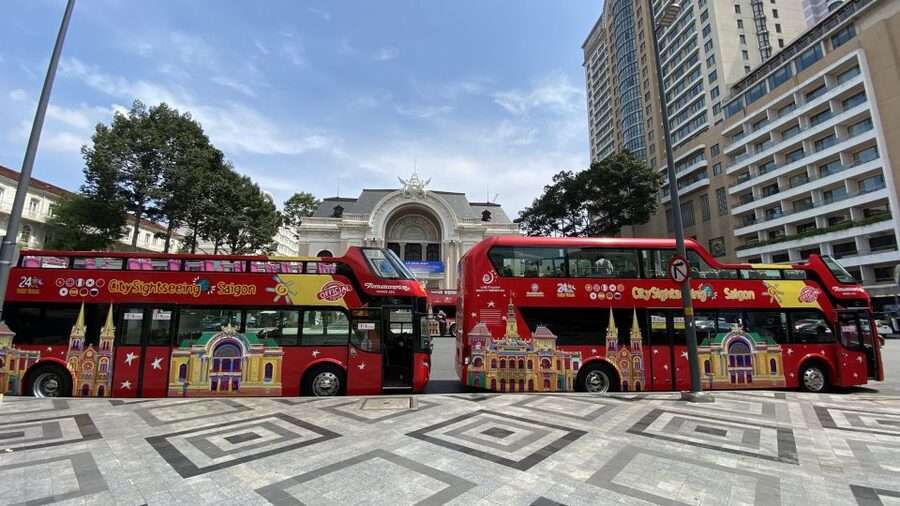
Saigon is easier when you can ride above the mess. This hop-on hop-off bus tour gives you two daytime routes plus multi-language audio so you can build a plan for the rest of your Vietnam trip at your own speed. You’ll pass big-name landmarks and a few quieter corners too, without needing to master Saigon traffic on day one.
What I like most is how fast it helps you get your bearings. The free guidebook (with maps, recommendations, timetables, and coupons) is a practical extra, especially when you’re sorting out what to do next. The tour also comes with headphones and recorded commentary in nine languages, so you’re not stuck doing guesswork.
One thing to consider: this is self-paced touring with recorded audio, not a live, custom guide. If the audio volume or timing doesn’t match the view you’re seeing (it can happen), you’ll want to use the bus staff at stops to fill any gaps and keep your day smooth.
In This Review
- Quick Takeaways for Saigon on a Double-Decker Bus
- Why This Hop-On Hop-Off Tour Works in Ho Chi Minh City
- Your Ticket: Price, Duration, and How to Think About Value
- How the Routes Are Timed (Red vs Blue)
- Using the Hop-On Plan the Smart Way
- Enter Stop 1: Opera House to Nguyen Hue Street
- Red Route Stops That Are Worth Your Feet
- Nha Rong Wharf: A Waterfront Break
- Tran Hung Dao Statue: A Photo Stop You’ll Remember
- Museum of Vietnamese History: For When You Want Real Context
- War Remnants Museum: The Stop That Changes the Tone
- Pham Ngu Lao Street: Base for Food and Easy Walking
- Ben Thanh Market: Shopping and Street-Food Glimpse
- Independent Palace: A Landmark Stop for Later in the Day
- Saigon Notre Dame Cathedral / Central Post Office: Classic, Central, Photo-Ready
- Blue Route Stops That Feel Like a Different Saigon
- Beer Street – Pham Ngu Lao Street
- Ben Thanh Market (Again)
- War Remnants Museum (Again)
- Ho Thi Ky Flower Market: Color and Everyday Commerce
- Phuoc An Society’s Premises and Ong Bon Pagoda
- Binh Tay Market and Thien Hau Pagoda
- Van Phat Pagoda
- Audio Guide, Headphones, and the Reality of Recorded Narration
- Comfort Details That Make the Difference
- Where the Bus Stops Actually Matter
- The Night Tour Mention (What You Can Infer)
- Who This Tour Fits Best (and Who Might Skip It)
- Should You Book the Saigon Hop-On Hop-Off Bus?
- FAQ
- FAQ
- How long is the Red Route?
- How long is the Blue Route?
- When do the buses start and end on the Red Route?
- When do the buses start and end on the Blue Route?
- How often do buses run?
- What languages are included in the audio guide?
- Can I use a mobile voucher or paper voucher?
- Is entrance to attractions included in the ticket?
Quick Takeaways for Saigon on a Double-Decker Bus

- Two routes (red and blue) that cover major District 1 sights and areas beyond, so you don’t waste time zigzagging
- Headphones + 9-language audio that help you connect what you see with quick context
- Top-deck views for photos and skyline moments, with the option to sit downstairs in air-con
- Free Wi‑Fi and a guidebook that make the tour feel like a travel tool, not just a ride
- Flexible timing with frequent departures on the red route, plus hop-on/hop-off freedom for shopping and museums
- Staff support when you’re trying to find the right stop or stay comfortable in sun or rain
The big Saigon sights in one loop




Why This Hop-On Hop-Off Tour Works in Ho Chi Minh City

Saigon moves fast. Even if you love wandering, the city is big, and the traffic is… a lot. This bus tour gives you a calm, repeatable way to see the main sights, understand the city layout, and decide what’s worth your time on foot.
The value is strongest if you treat the bus as your “orientation pass.” One loop can help you spot neighborhoods, landmarks, and viewpoints. Then you jump off where you actually want to linger—museum time, market time, or just a slow walk to grab street food.
You can buy a 1-day or 2-day pass, and that matters. With one day, you’ll likely choose a route and commit to the stops you care about most. With two days, you can repeat a route to catch what you missed and switch between red and blue so the coverage feels complete rather than scattered.
Your Ticket: Price, Duration, and How to Think About Value
The tour costs $21 per person, and it’s valid for 1–2 days depending on what you choose at checkout. For a city with paid attractions and lots of transportation options, that price can either feel like a bargain or like a “why not just take Grab?” situation.
Here’s the practical way to judge it: the bus becomes good value when you’re making multiple stops across different parts of the city. If you hop on and off just once or twice, you might spend more than taking a direct taxi to your top two or three places. But if you plan to do several key sights—Cathedral area, museum district, markets, pagodas, and viewpoints—the bus can save you both time and energy.
The other hidden value is the included onboard info. The commentary plus the guidebook help you avoid the common tourist problem: seeing something, then learning nothing and moving on. Even when the narration is recorded, it still gives you context quickly.
How the Routes Are Timed (Red vs Blue)
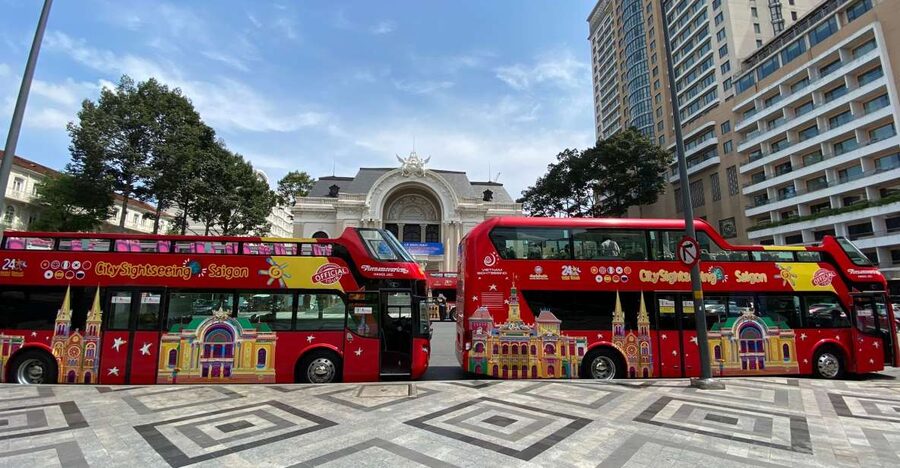
You’ll ride on two lines that differ in coverage and timing.
Red Route
- First departure at 9:00am from Stop 1
- Last departure at 4:00pm from Stop 1
- Frequency: every 30 minutes
- Tour duration: 75 minutes
Blue Route
- First departure at 9:00am from Stop 1
- Last departure at 3:45pm from Stop 1
- Frequency: every 45 minutes
- Tour duration: 80 minutes
If you’re tight on time, the red route’s more frequent departures make it easier to build a schedule around museum openings or a planned dinner. If you want variety, the blue route adds a different set of neighborhoods and religious sites, plus a market mix that’s worth comparing to Ben Thanh.
Using the Hop-On Plan the Smart Way
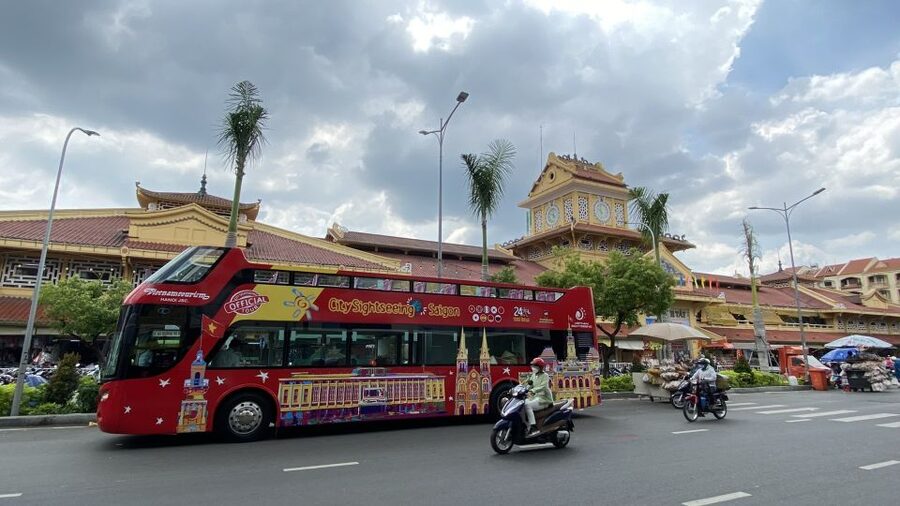
The biggest mistake people make with hop-on hop-off tours is treating every stop as a must. Instead, use the bus to decide.
I’d do this: ride at least one full loop first (both routes if you’re on a 2-day pass). Take photos from the top deck as you go. Then, on the second lap, hop off only where you want a longer look—like a museum, a market you actually want to shop in, or a cathedral area where you want time for photos and strolling.
You can switch between routes. A helpful detail: you’re advised to switch on the red route at Stops 6, 7, and 8, which correspond to Stops 1, 2, and 3 on the blue route. That’s useful when you notice you want to move from the museum area toward the pagodas and markets on the other line.
Top deck down, more loops of the city
- Ho Chi Minh City: Hop-On Hop-Off Bus Tour by Vistra★ 4.2 · 17 reviews
- Ho Chi Minh City Hop-On Hop-Off Bus Tour | Vietnam★ 3.5 · 9 reviews
- Ho Chi Minh City Night Hop-On Hop-Off Bus Tour★ 3.5 · 4 reviews
Enter Stop 1: Opera House to Nguyen Hue Street
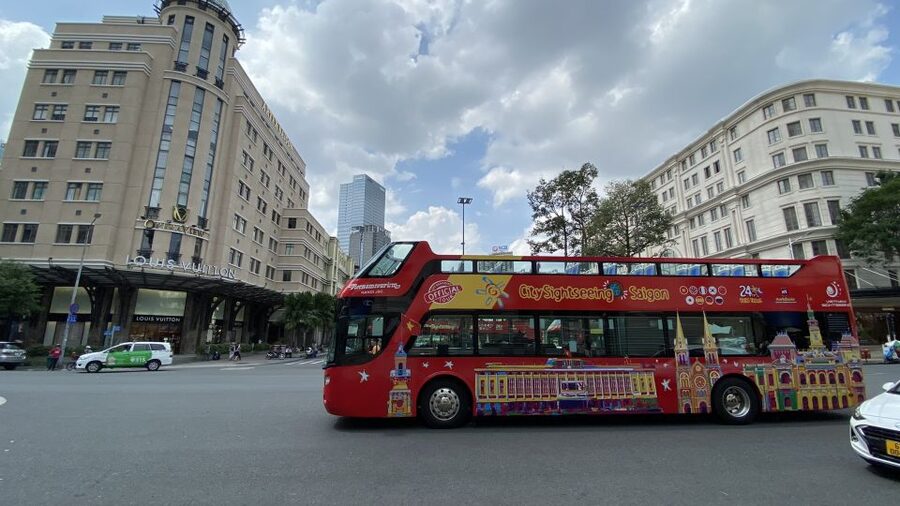
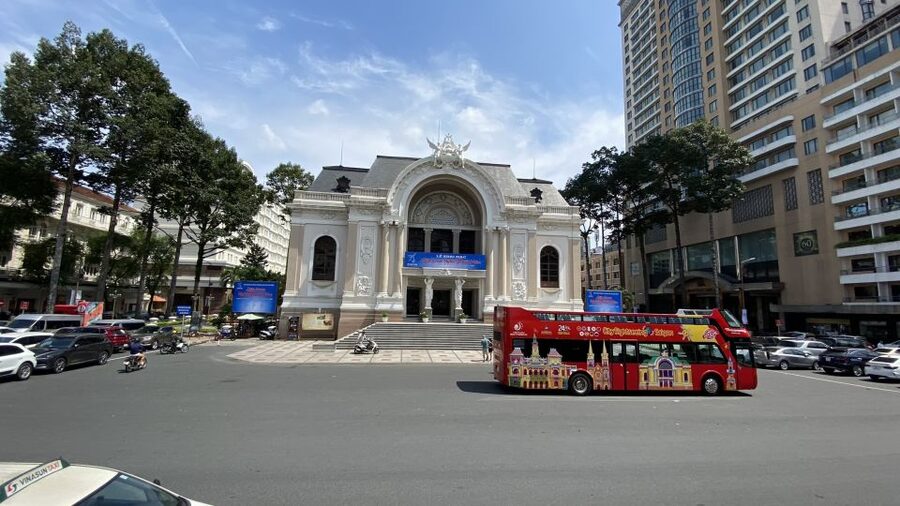
Most days, your journey starts at the Saigon Opera House area (Stop 1 on both routes). It’s a good “anchor” stop because it’s central and easy to use as a meeting point for your own plans.
From there on the red route, you head toward Nguyen Hue Street, a long stretch that’s ideal for understanding the city’s central core. Even if you don’t jump off here, riding past gives you a feel for how Saigon’s main streets connect.
What’s worth doing: use this early part of the day to figure out where you want to be later. If you know you want market time and museum time, you can plan those stops for when the sun is less intense.
Red Route Stops That Are Worth Your Feet
Nha Rong Wharf: A Waterfront Break
On the red route, Nha Rong Wharf is a quick shift in mood from downtown streets to the water-adjacent side of the city. It’s not a long sit-and-stare stop, but it helps you see that Saigon isn’t only about big boulevards and landmarks.
Tran Hung Dao Statue: A Photo Stop You’ll Remember
The Tran Hung Dao Statue stop is the kind of landmark you can treat as a break—short photos, quick orientation. You don’t have to spend ages here, but it can help you break up the ride into manageable chunks.
Museum of Vietnamese History: For When You Want Real Context
The red route includes the Museum of Vietnamese History. If you like museums, this is a strong “hop off and commit” stop. You’ll see why people pair this area with the next major stop on the red line.
Practical tip: when you hop off for a museum, give yourself real time. Recorded audio can only do so much; the museum is where you slow down.
War Remnants Museum: The Stop That Changes the Tone
The War Remnants Museum (also on the blue route) is one of the most important stops on either line. It’s not a light, casual visit, so plan it like one: bring patience, expect emotion, and decide in advance how long you want to spend inside rather than trying to rush.
If you’re doing both routes in two days, this museum becomes a strategic center. You can hop off here on day one, then return later if you want more time.
Pham Ngu Lao Street: Base for Food and Easy Walking
Next on the red route is Pham Ngu Lao Street, often a practical base area with plenty happening. If you want street-level energy and easy meal options, this is where you’ll notice Saigon’s day-to-day rhythm.
Ben Thanh Market: Shopping and Street-Food Glimpse
Then comes Ben Thanh Market. This is an easy “yes” stop if you want souvenirs and snack breaks without leaving the main tourist circuits. The market also works as a people-watching spot—just remember to budget time for browsing.
Independent Palace: A Landmark Stop for Later in the Day
The Independent Palace is another major red route stop. If you like political history and architecture, it’s a strong pick for a longer visit. Timing can matter—if you’re pairing it with other stops, try to avoid packing too much into one late-afternoon rush.
Saigon Notre Dame Cathedral / Central Post Office: Classic, Central, Photo-Ready
Finally on the red route, you’ll reach the Saigon Notre Dame Cathedral / Central Post Office stop. This is the area where you can combine postcard photos with a calmer walk around the buildings.
One practical note: this zone is central and popular, so expect crowds. The bus still helps because it gets you there without stress and lets you hop off for a specific window of time.
Blue Route Stops That Feel Like a Different Saigon
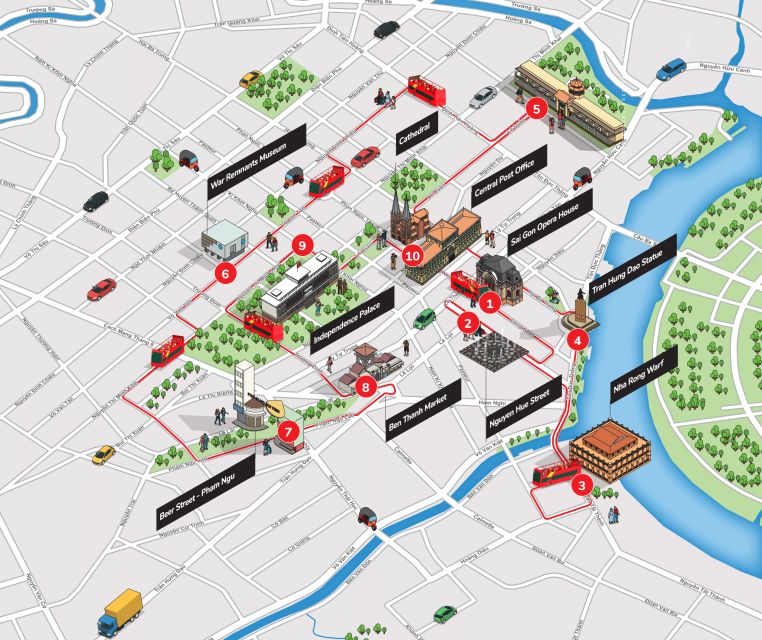
The blue route is where the tour starts to feel less like a straight-through highlights reel. It adds markets, flower stalls, and pagodas that broaden your sense of what daily life looks like outside the most obvious landmarks.
Beer Street – Pham Ngu Lao Street
The blue route starts in a similar general area with Beer Street – Pham Ngu Lao Street, giving you an easy transition point between the two lines. If you’re starting on red and want to drift into blue, this connection helps.
Ben Thanh Market (Again)
Ben Thanh also appears on the blue route. This is convenient. You don’t need to force a perfect schedule; if you skipped Ben Thanh on red, you can catch it on blue.
War Remnants Museum (Again)
War Remnants Museum is on the blue route too, making it the tour’s backbone stop for both lines. If you’re short on time and only choose one stop that matters, this is the one.
Ho Thi Ky Flower Market: Color and Everyday Commerce
Next up is Ho Thi Ky Flower Market. This is the kind of stop that’s best for an early-to-midday visit when you can actually look around. Even if you don’t buy anything, you’ll get a sense of the city’s rhythm and commerce.
Phuoc An Society’s Premises and Ong Bon Pagoda
On blue, you’ll also find Phuoc An society’s premises and Ong Bon pagoda. These stops aren’t just scenic—they show how religious and community spaces sit inside real neighborhoods.
This is also a route where hopping off for a short walk can be more rewarding than treating every stop as a quick photo.
Binh Tay Market and Thien Hau Pagoda
Then you hit Binh Tay Market, followed by Thien Hau Pagoda. This pair is a nice contrast: market energy and religious calm in the same general flow. If you’re deciding whether blue is worth it, this is a big reason to give it at least part of a day.
Van Phat Pagoda
The blue route ends with Van Phat Pagoda. If you like quiet breaks during a busy day, this works well as a closing stop—especially if you’ve already done your museum and market time earlier.
Audio Guide, Headphones, and the Reality of Recorded Narration

The audio guide is included in English, Spanish, German, French, Chinese, Japanese, Korean, Vietnamese, and Russian, and you get headphones. For most first-time visitors, that’s the real win: you can understand what you’re seeing without digging through your phone.
That said, recorded audio has limits. Some people report cases where it doesn’t line up perfectly with what the bus is passing, especially on the blue line. If your audio feels off, you can still solve the problem: glance out the window, ask staff for the next stop context, and treat the narration as helpful background rather than an exact script.
Also pay attention to volume. Ho Chi Minh City is noisy, and even with headphones, you might want to turn the audio up and test it early.
Comfort Details That Make the Difference

This bus experience is more pleasant when you’re comfortable in the heat and weather.
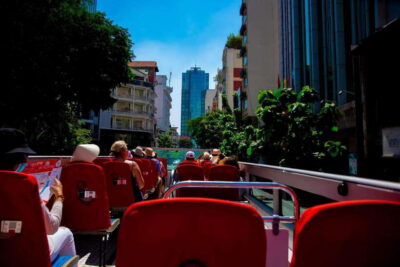
You can sit on the top deck for views, but the sun can be strong. Many people love the skyline and photo angle up top, and you’ll likely want to swap between the open view and the shade when needed.
Downstairs, you can find air-con, which is a big deal during hotter parts of the day.
On rainy days, the staff have been ready with help like ponchos, and they may offer hats when it’s hot. That’s not glamorous, but it’s practical. It keeps your day moving instead of ending early because you’re soaked.
Where the Bus Stops Actually Matter
The stops are near major sights, which helps a lot. Still, a hop-on hop-off bus isn’t magic: a few stops can mean some walking to reach the exact entrance you want.
Also, signage at stops can be inconsistent, so don’t assume every stop will look like the same kind of branded platform. Use the bus staff to confirm which route you’re boarding. It’s fast, and it saves you from waiting at the wrong spot for a bus that won’t come.
The Night Tour Mention (What You Can Infer)
The data you provided references a night tour as an add-on-style experience and describes it as a must-do for many people who do the bus after dark. Even though the day routes are the core of the two-line system, the idea is clear: you can see lighting and skyline effects that you won’t get in daylight.
If night views matter to you, consider building your 2-day plan so you’re not exhausted after a long museum day. A cooler evening loop often feels like the reward after the hard-hitting sights.
Who This Tour Fits Best (and Who Might Skip It)
I’d recommend this bus tour if:
- You want a quick Saigon orientation in your first 1–2 days
- You like hopping off for museums and markets without planning every minute
- You prefer an easy rhythm over navigating street-by-street
I’d think twice if:
- You’re only interested in one or two places and you’ll go direct by taxi
- You hate recorded narration and want live, tailored explanations
- You’re the type who needs perfect stop-by-stop accuracy and hates any audio mismatch
For families, the flexible hop-on approach can be a lifesaver because you can adjust pacing without everyone committing to a long walk at once.
Should You Book the Saigon Hop-On Hop-Off Bus?
Book it if you want an efficient first look at Ho Chi Minh City with enough flexibility to shape your next moves. At $21, it’s especially compelling when you plan multiple stops across both routes or you’re doing this early enough to guide the rest of your trip.
Skip it (or at least keep expectations realistic) if you’re thinking of using it like a one-stop shuttle. This is a tour that shines when you ride, then decide. It’s not meant to replace every taxi or every walking hour—it’s meant to help you stop guessing and start exploring.
FAQ
FAQ
How long is the Red Route?
The red route ride duration is about 75 minutes.
How long is the Blue Route?
The blue route ride duration is about 80 minutes.
When do the buses start and end on the Red Route?
The first departure from Stop 1 is at 9:00am, and the last departure from Stop 1 is at 4:00pm.
When do the buses start and end on the Blue Route?
The first departure from Stop 1 is at 9:00am, and the last departure from Stop 1 is at 3:45pm.
How often do buses run?
On the red route, buses run about every 30 minutes. On the blue route, buses run about every 45 minutes.
What languages are included in the audio guide?
The audio guide is available in English, Spanish, German, French, Chinese, Japanese, Korean, Vietnamese, and Russian.
Can I use a mobile voucher or paper voucher?
Yes, both mobile and paper vouchers are accepted.
Is entrance to attractions included in the ticket?
No. Entry to attractions is not included, and food and drink are also not included.
More Tour Reviews in Ho Chi Minh City






Open Top Saigon: More Bus Loops


All of Saigon in a Day
Just Reviewed Around Saigon
- Secret walking Food Tour Ho Chi Minh City
★ 5.0 · 3 reviews - Ho Chi Minh City: Secret Cocktail Experience
★ 5.0 · 3 reviews - From Ho Chi Minh city: Vung Tau Beach Private Day Tour
★ 5.0 · 3 reviews - Saigoncholon
★ 3.5 · 3 reviews - Saigon On 2 Wheels
★ 3.5 · 3 reviews - From Ho Chi Minh City: Relax In Mui Ne Beach In 1 Day
★ 4.3 · 3 reviews
Saigon City Tours, compared.
 ★ 4.9City Highlights and Saigon Unseen Scooter Combo TourFrom $251,366 reviews
 ★ 4.3City Sightseeing 45-Minute Panoramic Night TourFrom $7964 reviews
 ★ 5.0Small-group Saigon City Tour: 4-Hour Must-see Iconic LandmarksFrom $30788 reviews
 ★ 5.0Essential Mekong Delta: Highlights Tour from Ho Chi Minh CityFrom $23636 reviews
 ★ 5.0Daily Small Group Tour to Saigon City and Cu Chi TunnelsFrom $50412 reviews
 ★ 5.0Ho Chi Minh City Tour by Motorbike with Female Riders | KissTourFrom $46330 reviews
 ★ 5.0Cu Chi Tunnels – Tapioca & City Tour (6 Major Attractions) 1 dayFrom $72285 reviews
 ★ 5.0Full-Day Ho Chi Minh City Tour with Colonial Heritage & ChinatownFrom $47246 reviews
Browse the lists this tour appears in